There is a comfortable assumption in equipment hire: the machine belongs to someone else, so the compliance does too.
It does not work that way. Under the Heavy Vehicle National Law, responsibility is assigned by what you do, not by what you own or what your job title says. If your decisions influence how a heavy vehicle is loaded, scheduled or driven, you are in the Chain of Responsibility — whether or not you have ever thought of yourself as a transport business.
For civil contractors and councils moving plant between sites, that is worth understanding properly.
What Chain of Responsibility actually is
Chain of Responsibility, or CoR, extends legal duty beyond the driver to everyone whose actions affect the safety of a heavy vehicle’s use.
The law identifies ten functions that make you a party in the chain: employer, prime contractor, operator, scheduler, consignor, consignee, packer, loading manager, loader and unloader.
Note that these are functions, not titles. A project manager who sets an unrealistic delivery window is scheduling. A site supervisor who directs how a roller is loaded onto a float is acting as a loading manager. Neither of them has “transport” in their job description. Both are in the chain.
The primary duty
Every party in the chain carries the same primary duty: to ensure, so far as is reasonably practicable, the safety of their transport activities.
In practice that means conducting your activities so that they eliminate public risks — and only where elimination is not reasonably practicable, minimise them. It also means not directly or indirectly causing or encouraging a driver to breach the law, to exceed a speed limit, or causing another person to breach it.
Those two words — directly or indirectly — are the reason a scheduler sitting in an office is in the chain at all.
“So far as is reasonably practicable” is the phrase that does the work. It does not require perfection. It requires that you knew the risk, took proportionate steps, and can demonstrate both.
That last part is where most organisations are exposed. Not because the practice is poor, but because the evidence is not there when it is asked for.
Executive duty runs above it
There is a second duty that sits with company executives and directors, and it is not delegable. Executives must exercise due diligence, which the law breaks into five obligations:
gain and keep up to date knowledge about safe conduct of transport activities
understand the hazards and risks associated with the business’s transport activities
ensure the business has and uses appropriate resources to eliminate or minimise those risks
ensure the business has and implements processes for eliminating or minimising those risks, for receiving, considering and responding in a timely way to information about hazards, risks and incidents, and for complying with its safety duties
verify that those resources and processes are being provided, used and implemented
“I left it to operations” is not a defence. The verification step is explicit — and note that it requires verifying the processes are actually being used, which is a lower bar than proving they work but a higher bar than having them on file.
Where plant hire fits
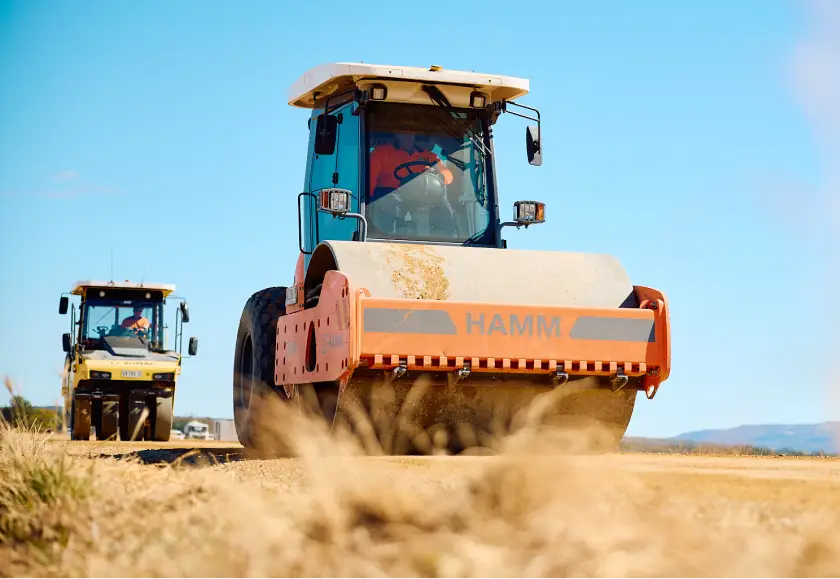
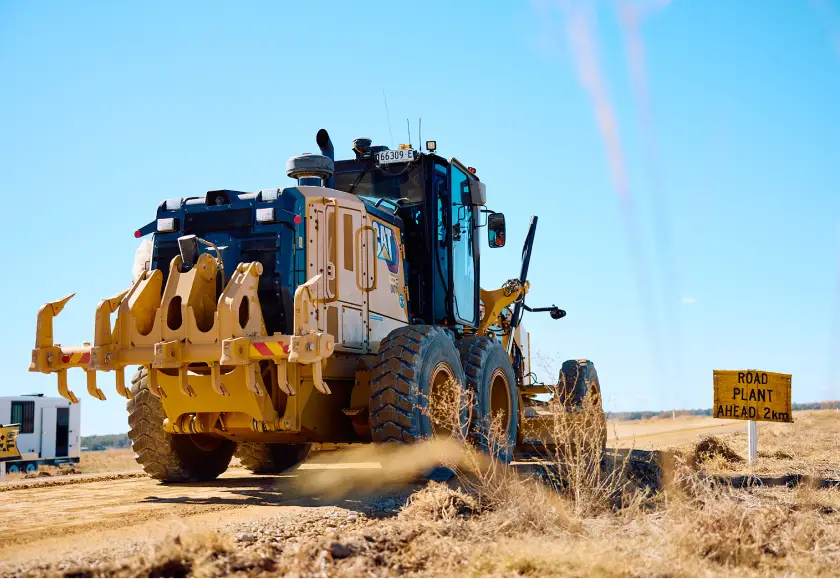
Move a roller, grader or water cart between sites and a heavy vehicle is involved. Several CoR functions activate immediately.
Mass, dimension and loading. A tracked or drum machine on a float has to be within mass and dimension limits, correctly positioned and properly restrained. Both the party loading it and the party directing that load carry duty.
Scheduling and fatigue. Delivery windows that can only be met by speeding or by driving beyond regulated hours create liability for whoever set the window — not just for the driver who tried to meet it.
Vehicle condition. Roadworthiness, maintenance records and defect reporting for the float and prime mover sit with the operator, but a party who knowingly uses a non-compliant carrier is not insulated.
Access and permits. Oversize and over-mass movements need the right permits and routes. Regional and council roads add load limits and structure constraints that a metropolitan operator may not be across.
None of this transfers to the hire company by virtue of the invoice. Duties in CoR are shared, not passed along.
And CoR is only half of it
CoR governs the vehicle. Work health and safety law governs what happens once the plant is on site — and there, duties are similarly shared between the person who supplies the plant and the person who uses it.
The supplier’s duties run to plant that is safe, maintained and provided with the information needed to use it safely. The user’s duties run to competent operators, safe systems of work, and a site where the plant can be used without exposing people to risk. If the hire includes an operator, the supplier’s duties extend further, into competency, supervision and fatigue.
Both bodies of law point at the same practical question: can you show what you did, and why it was reasonable?
What to ask a hire supplier
Compliance capability is difficult to assess from a website. These questions get past the marketing.
How do you manage mass, dimension and load restraint for plant movements? Look for documented procedures and restraint calculations, not “our drivers know what they’re doing.”
Can you produce maintenance and pre-start records for a specific machine? A supplier with real systems can pull the history of the unit you hired. A supplier without them will offer a general assurance.
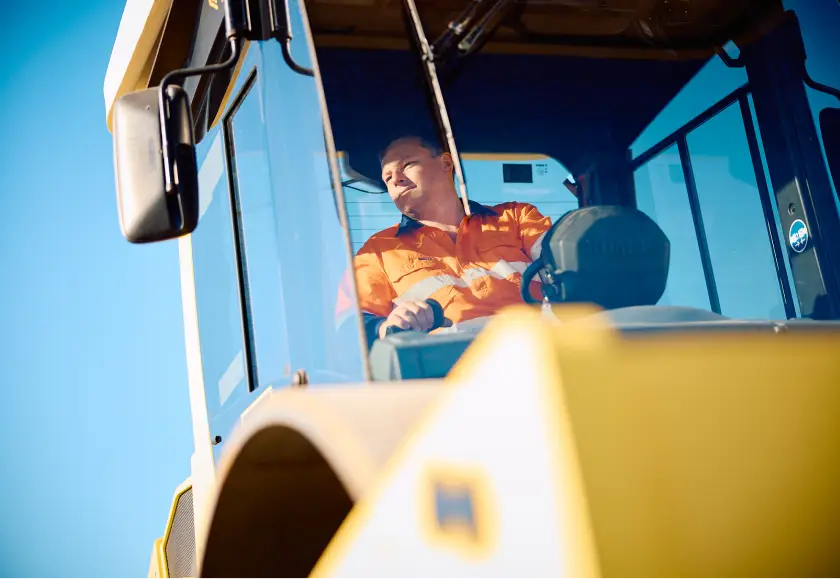
How do you verify operator competency, and how often? For wet hire, this is the whole ballgame. Tickets on file is a starting point. Currency, verification of competency and site-specific induction is the standard.
Who is accountable when something goes wrong at 4pm on a Friday? You want a name and a number, not a call centre queue. Ask who that person is before you need them.
Will you support our tender submission with evidence? Councils and Tier 1 principals increasingly require supplier compliance evidence within the submission. A supplier who can hand it over promptly is worth more than a marginally cheaper day rate.
If a supplier struggles with any of these, that is not a paperwork problem. It is an indication of how the business is run.
Compliance is a commercial position, not a cost
There is a view in the hire market that compliance is overhead — a drag on margin in a price-driven industry.
We take the opposite view. Structured systems mean predictable delivery. Maintained plant means fewer breakdowns. Verified operators mean fewer incidents and less rework. Documented processes mean a tender response that takes hours instead of days. Every one of those is a commercial outcome, not just a legal one.
It also extends past the vehicle. Compliant site amenities are part of the same picture — which is why MoCrib designs and supplies mobile, solar-powered lunchrooms and facilities built to meet welfare requirements without a mains connection or a temporary-works headache. Compliance that is practical on a regional site, rather than compliance that exists on paper.
The short version
Hiring plant does not hire out your obligations. It shares them with a supplier — which makes that supplier’s systems part of your risk profile.
Rollers Australia operates with structured WHS systems and a documented Chain of Responsibility policy, and can provide that evidence when a submission calls for it. Family-owned, based in Tamworth since 1999, supporting civil contractors and infrastructure teams across regional NSW and QLD.
If you need supplier compliance evidence for a tender or a project induction, ask us. Get in touch.