Most guides to compaction rollers start with the machines. Here is a smooth drum, here is a padfoot, here is what each one weighs.
That is a catalogue, not a decision. Crews who get compaction right do not start with the machine. They start with the specification, work back through the material, and the machine falls out of that.
So let us do it in that order.
Start with what the spec asks for
Before anything else, know the target. On most civil work in NSW and QLD that means a relative compaction figure against a standard or modified compactive effort — commonly expressed as a percentage of maximum dry density, with a permitted moisture range around optimum.
Three things flow from that number.
How much energy the material needs. A high modified-compaction target on a subgrade demands far more effort than a nominal figure on general fill.
How thick the layers can be. Lift thickness is not a site preference, it is a function of the machine’s effective depth. Ask a 12-tonne smooth drum to compact a 400mm lift of clay and you will get a well-sealed crust over an uncompacted middle. It will test fine at the surface and fail where it matters.
How the result gets verified. If sand replacement or nuclear density testing is coming, you need to hit the number, not approximate it. That changes how much machine you bring.
If the spec is not clear, get it clarified before mobilising. Guessing at this stage is the single most expensive mistake in compaction.
Then look at the material
Compaction behaviour splits broadly into two families, and they want opposite things.
Cohesive materials — clays and silty clays — hold together through particle attraction. They resist compaction from the surface down and need the compactive energy driven into the layer. That means kneading and pressure, not vibration alone.
Granular materials — sands, gravels, crushed rock, road base — compact by particles rearranging into a denser packing. Vibration does this efficiently, because it momentarily reduces friction between particles and lets them settle.
Moisture governs both. Too dry and the particles will not move into position. Too wet and water occupies the void space you are trying to close, and the material will pump under the drum rather than densify. Most specifications set a window around optimum moisture content for exactly this reason, and on a hot regional day that window closes fast — which is why water carts are compaction plant, not an afterthought.
Now the machines
With the spec and material understood, the selection becomes straightforward.
Smooth drum rollers
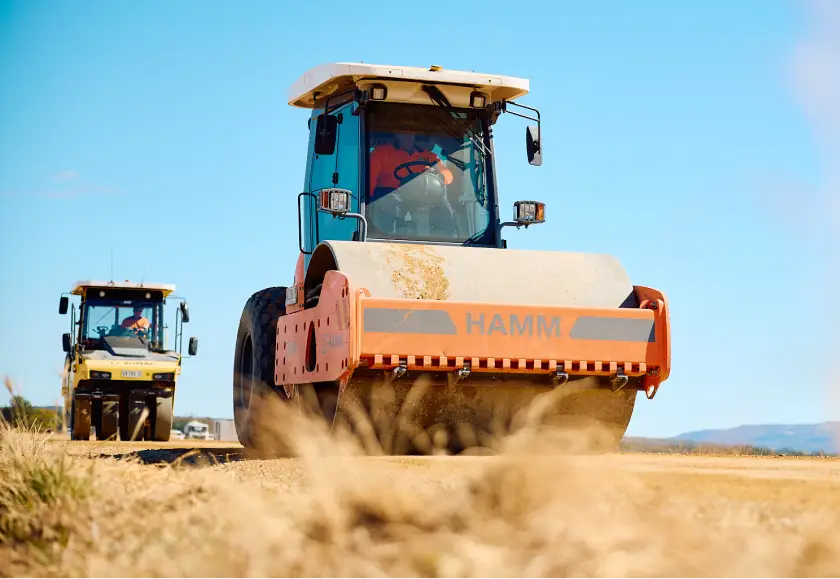
A flat steel drum, usually with a vibratory function. The workhorse for granular materials — road base, gravels, sands and sub-base — and for finishing work where a smooth surface is required.
Use it when the material is granular, the lift is within the machine’s effective depth, and you need a sealed, trimmable surface. It is the wrong tool on wet clay, where the drum will bridge over the top and leave the layer beneath untouched.
Padfoot rollers
A drum studded with projecting feet. Those feet concentrate load onto a small area, driving pressure into the layer and kneading the material as they walk through it.
This is the machine for cohesive clays and silty subgrades, and for thicker lifts where you need energy delivered below the surface. A padfoot works from the bottom up — early passes leave the surface open and rough, and it gradually “walks out” as the layer densifies. That walking-out is a useful field indicator that the layer is approaching target.
Padfoot is the wrong choice for a finished surface. It leaves an intentionally rough profile, which is fine for bonding the next lift but not for a running surface.
Multi-tyred rollers
Rows of rubber tyres, usually ballasted, with a kneading action and a degree of flexibility the steel drums do not have.
Best for sealing — closing up the surface of a granular layer, and working asphalt without checking it (the hairline surface cracking a steel drum can induce). The kneading action also makes it useful on materials that respond poorly to vibration.
Multi-tyred rollers are also used to identify soft spots by watching for deflection under the tyres, though be aware that many Australian specifications nominate a loaded truck of specified axle mass as the proof-rolling vehicle rather than a roller. Check what your spec actually calls for.
Trench rollers
Compact, remote-operated, and built for confined work — service trenches, batters, backfill against structures and anywhere a full-size machine cannot safely go. Usually padfoot drums, because trench backfill is often cohesive.
Their value is as much about safety as compaction: remote operation keeps a person out of an unsupported trench.
Grid rollers and specialty plant
Grid rollers break down oversized material and are useful on weathered rock and softer aggregates. Tractor-drawn units and broom sweepers sit alongside the main fleet for site preparation and cleanup, which is unglamorous work that nonetheless determines whether the next layer bonds properly.
Size is a specification decision, not a preference
Bigger is not automatically better. Over-compaction is real: excessive energy can shear a cohesive layer, break down aggregate gradings and reduce the density you were chasing.
Match machine weight and drum amplitude to the layer thickness and material. On a thin finishing lift, a heavy vibrating drum can do more harm than a lighter one. On a deep clay subgrade, an undersized machine will never reach the bottom of the layer no matter how many passes you run.
Verify, do not assume
Pass counts from experience are a starting point, not a result. Conditions change across a site — material sources vary, moisture changes through the day, and subgrade support is rarely uniform.
Intelligent compaction and on-board compaction meters give operators a live read on stiffness as they work, which turns pass counts into evidence and highlights soft areas before the testing crew finds them. On specification-driven work, that visibility pays for itself the first time it prevents a rework.
Where this goes wrong
The failures we see most often are not exotic. Wrong roller for the material. Lifts too thick for the machine. Moisture outside the window because the water cart was cut from the program. And an operator who has run a roller before but has not been taught what the material is telling them.
Each of those is avoidable in the planning, and expensive in the rework.
Talk it through before you book
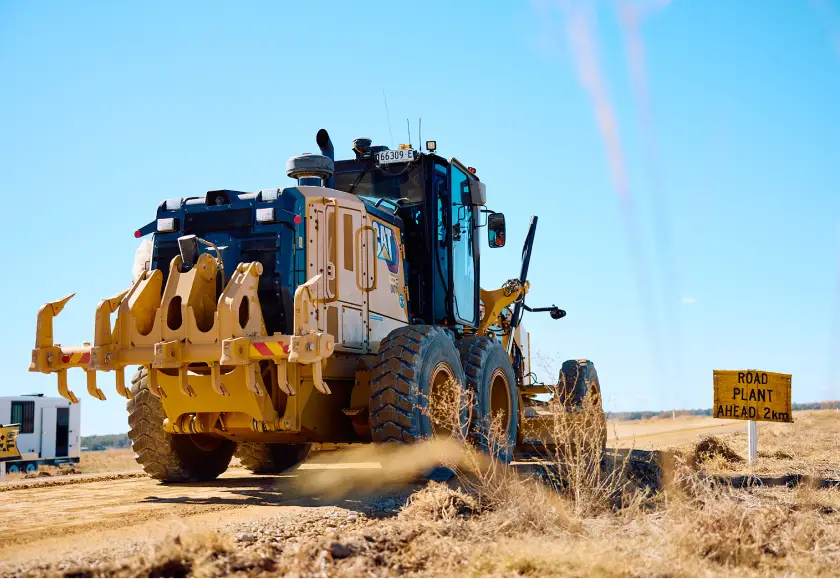
Our fleet is built specifically for compaction and civil support — smooth drum, padfoot, multi-tyred, trench and grid rollers, water carts, graders, sweepers and compaction meters. That focus is deliberate. It means the conversation about which machine suits your material is a conversation with people who do this every day, not a lookup against a catalogue.
We also run compaction and operator training, because the machine is only half of the result.
Family-owned, based in Tamworth since 1999, supporting civil contractors and infrastructure teams across regional NSW and QLD.
Send us the spec and the material, and we will tell you what the job needs. Get in touch or browse the fleet.